-----In 2004 we bought a falling-down house and 30 acres. This blog documents our progress-----

Monday, April 05, 2004

soil test results

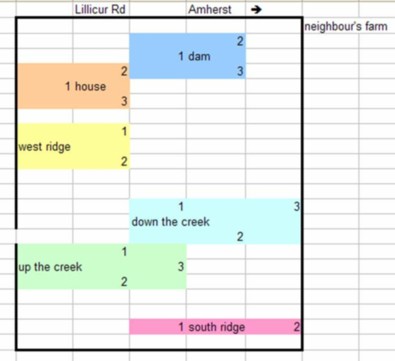
These are the results of the soil testing which Dave's parents did, with some help from Mum and Dad

soil testing results

soil testing map

Overall, the pH seems to be between 5-6, so slightly acidic, although not as bad as I was expecting. The other minerals are worse than I'd anticipated though... I guess it just means we have to do a lot of preparation of the soil in advance; but in the scheme of things it's not impossible.


The tests were done after about 5 years of low rainfall, so all the soil was very dry. After clearing, the land was probably used for grazing, and at testing, grass was dry and sparse to very sparse. The soil is a grey to reddish brown loam
In most areas there is 20 to 30cm topsoil with small to medium sized quartz fragments on the surface or in the soil. The area called up creek and down creek was probably a shallow gully which was filled over the years with soil washed from the uphill forest area. The top soil here is at least 30cm and is a fine dark grey loam with an absence of quartz fragments. This area supports the greatest quantity of grasses. The ph tests showed the creek soils to be slightly acid probably relatred to the humus content and overall the creek soil would be the easiest to cultivate and probably the most fertile.

Tuesday, March 30, 2004

email minutiae: Mum's idea of holiday cottage

Early on Mum and Dad asked whether we would consider letting them build a holiday cottage on the property, but then it seemed to morph into granny flat. Hopefully now it is back at holiday cottage for occasional stays as we don't really want to have anyone else living there permanently if we can avoid it... Anyway, here's the initial exchange of emails:

Mum's initial email - 6th March 2004
When we were measuring, I said it would be lovely to be able to have a little place there. I was not going to say it, but Dad said to before you got planning. Is it possible you would agree to a little place or two being built? You were talking B&B, so this would really just be that. A little unit with a bedroom, lounge/kitchen or sucjh. Jess and Tony could bisit, me, Dad, whoever. nice to be able to maintain some privacy if needed. You could put such a place out of sight of the main house if you wished.

My reply - 7th March 2004
Actually, I was already thinking of planning in space for a separate cottage which could be used for B&B or just rented out for short holidays, and also used when people come to visit. It wasn't going to be top of the list in terms of building, but I was going to plan in space for it. The idea at the moment is to create a series of garden "rooms", but also build in some long views too. I don't want to count just on the views though down the valley because I have no control over them remaining... so want to take advantage of them but also have a secondary plan that is easy to implement if someone builds a horrible house next door and blocks it. Anyway, the cottage would effectively be in it's own garden room so screened naturally from the house. Do you remember how the cottages at that place in Belgrave were screened? They were a lot closer than this would be but they were well done in the sense of blending in and feeling secluded.

Email from Mum - 27th March 2004
A few weeks later Mum referred to it again: I said I had asked about a granny flat - Jess said it would be a good idea! Later joked you two should hurry up and build them as it would save us all having to go into a nursing home! No-one would care if you went about in your nightie at 5pm for example.

My response - 29th March 2004
On the "granny flat", not sure what you mean by this but just to avoid confusion... all Dave and I have discussed and he has agreed to is to build (eventually) a separate self contained small cottage we could use for friends/family to stay in for weekends / whenever they came and visited, and also suitable for renting out for B&B as that would be one of the ways we'd hope to make some income in the longer term. We weren't planning on it being close to the house or set up like a nursing home flat, which is my interpretation of "granny flat"?

Tuesday, March 23, 2004

article about Amherst and Talbot from Goldnet magazine (April 2000)

14. TALBOT - AMHERST
by Roger Rhodes
"Tucked away just about 10 miles south of Maryborough are the small rural communities of Talbot and Amherst. These days Amherst is just an intersection on the map and a couple of buildings, but the old village of Talbot, is like driving back into the past as one enters the town. About the only thing missing is the period costumes and the odd horse and rider or horse and cart. Of course most of the roads are now bitumen.

Driving past this little hamlet one could be forgiven for not taking a second glance, but then as we drive on major highways these days that is a common occurrence. The main road south from Maryborough glances along the edge of Talbot as it meanders along with its 100km/h speed limit. Just turn left when you get there, and drive into history.

main street talbot

Although gold was discovered in early 1854, it was not until the later that decade that a more permanent town became a reality. Previously there had been quite a tent city housing up to 15,000 on Back Creek Flat. However in 1859 the Scandinavian Lead was located on the site of the present town, and within a few weeks 30,000 descended on this rich lead. In a short time more permanent buildings were erected, rather than the canvas stores that proliferated in the early days.

Fires take their toll of permanent structures in this hot dry climate, and Talbot was no exception. In fact from the time they were built in the 1860's buildings were lost from time to time. The latest bushfires in 1985 destroyed some buildings. Today the town of Talbot has few trees and is surrounded by clear paddocks, used for grain crops or grazing cattle and sheep. It almost appears that no gold was ever taken from this rich land, it has been transformed so much.

However just a short distance to the west of Talbot lies the area of Amherst. Once a thriving town in its own right - today very few buildings remain, many overgrown. In its former glory days the town was in the centre of a gold bearing belt that was about seven miles long and a mile wide. There were seven general stores, a surgeon and a grand Inn. A hospital commenced in 1857 operated into the 1920's.

The "Big Reef" is a massive quartz outcrop in State Forest and private property between Amherst and Lillicur, to the west. Companies worked the reef for many years, with great success. I have however, always found that the best ground to find gold these days in this area is around Amherst to the north towards the Adelaide lead. There are indeed, substantial diggings right through this area of the forest, and with a little patience and know-how good gold can be found here.

I know a few characters that regularly spend time in their favourite gullies and hills in this area and they are usually rewarded. I just happened on a retired farmer, who drives over from South Australia regularly, a trip of 400 miles, and he was good enough to show me some of his finds. I have been asked not to disclose exactly where he was for obvious reasons, but it was pretty close to one of those little towns let me tell you.

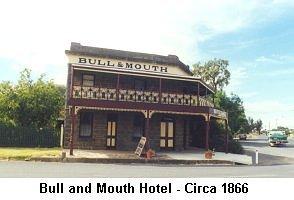
bull and mouth hotel

The Paddy's Ranges State Park dominates this area and it is here that there are substantial surface diggings that with patience can give up good gold. It should be remembered that this area produced a plethora of gigantic nuggets last century, and one often hears of large nuggets coming from this area. Joining this park the Amherst State Forest, Talbot State Forest and the Eglinton State forest present an outstanding opportunity to detect auriferous ground in a tranquil setting, even if the bush is a little thick throughout.

Personally I have always done well to the south of Talbot. Last time I was there I concentrated on the surfacing patches using the Coiltek elliptical coil attached to a Minelab 2200D. What I got was a lot of small gold in what one could describe as thrashed ground. I concentrated on the Butchers Gully and Little Nuggety Gully areas. Although the bush here is pretty thick in places there are more than enough areas to find a few pieces that have been missed.

The virgin ground here to the south when detected with the 18" Coiltek coil turned up a few pieces in some of the gully slopes. There is no question that the reputation that this area has for large nuggets is well deserved and continues to be a favourite with detectorists from all over the world. Don't forget that a lot of the country in this area is now privately owned, and permission must be sought to enter private ground.

When visiting this area take the time to visit both Talbot and Amherst and spend some time investigating this old mining town. The experience is very rewarding and you never know, one of the old timers just might give you a hint about where the real gold might still be found.

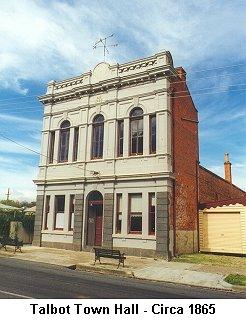
talbot town hall

Wednesday, March 17, 2004

email minutiae: initial discussions with Prue

I made contact with Prue via the contact form on her website, then we had a series of email and phone conversations as per extracts below.

Prue's reply to my initial contact - 9th March 2004

Thank you for your enquiry regarding garden design for you Amherst property. I have had a look at your photos and the property looks blissful, a world away from life in London. It certainly has potential for creating a beautiful garden.

Some ideas to begin with would be the need for water by way of a large dam to support the needs of the house and garden. It will also have significant ornamental value. The establishment of larger trees to create structure, height and shade is important, while being mindful of retaining views across the paddocks and to the state forest. From here finer details of 'garden rooms' and levels can be created and installed. A long term project, but all good gardens take time to create.

My suggestion would be to talk with you in order to get a feel for your desires for your Amherst property and also for you and I to see if our ideas and personalities are aligned. We can also discuss the approach to the design and the fee structure. I look forward to hearing back from you to organise a time to talk.

My reply - 9th March 2004

Thanks very much for the initial ideas, they make total sense... and don't worry, I'm under no delusions about this being a long-term project! I should also say upfront, I don't know how normal this is for your clients, but I'm keen to be very involved and hands-on. For me the opportunity to create a garden is the biggest reason for buying the property in the first place and so I want to feel like I have a big hand in that creation because otherwise it would be giving up on part of the experience. But, I think it's foolish to attempt to do something on such a grand scale without guidance, even if it is just someone who I can consult to stop me making silly mistakes. I'm by no means an expert gardener and I have no clue about gardening in Australian conditions. When we lived in Australia I didn't pay any attention to gardening...it was only here, around 5 years ago when we bought our London flat, that I started and was almost instantly hooked. Now I would say that gardening is a passion that I can't imagine being without.

At one point I was considering taking a course in garden design - e.g., the English Gardening School in Chelsea offers correspondance courses. But I gave up on that since I didn't want to turn gardening into "work" because I didn't want to risk it stopping being fun. However, I bought the textbook and have read 2/3rds of it so far...so I have some idea of how to start, but a theoretical understanding from reading is very different to that borne of practical experience! I had been just going to start off on my own and see how far I got, but then I came across your website while looking for info about dry gardening in Australia, and thought I'd get in touch.


Following this we had a long telephone discussion and I also sent Prue links to some photos of gardens we'd visited over here...

Prue's reply - 16th March 2004

Thank you for all the photos. It has made me want to visit England again in a hurry to see all the beautiful gardens. Thanks also for the photos of your garden. You have definitely fitted a lot into a small space. I have sent you through some photos of my garden, the first few are 'under construction'. It is looking much more lush now. I'll send you through some updated ones soon.

I have looked through all the information you have sent regarding Amherst and will print off copies of some of the site maps in order to start the design process.

Some plant and nursrey sites to look at are www.flemings.com.au, www.dandenongs-online.com.au, the Yamina Rare plants site, www.rankins.com.au for roses, www.pga.com.au for perennials, www.dinsan.com.au for general plant lines, www.larkmannurseries.com.au for perennials.

Hope that keeps you entertained for a while. I look forward to receiving further info from you regarding your likes & dislikes in plants/gardens etc, and any other info you come up with.

My long reply... so excited to be starting! 16th March 2004

Thanks very much for your proposal. The only thing I would say is do you have any idea how long something like this might take, just so I get a rough idea of how many hours might be involved (and hence total cost)? I think I'd like to go ahead but am worried about embarking on something totally open-ended for which I have no idea what the end cost will be. Even just a ballpark estimate would help. Also, in terms of the research... if you are thinking of visiting Bendigo, Castlemaine, etc... you are very welcome to visit our property too. It's not far from Maryborough, apparently that has a botanical garden and is a really nice little town. Also, if you want to combine it into a nice day out, I just found there's a farmers market in Talbot (5 mins from our place) between 10am-2pm on the 3rd Sunday of each month, starting March 2004 (ie: it's just started). tel: 03 5463 2008 if you're interested in finding out more.

In terms of the research, I will definitely help as much as possible, I'm pretty good usually at tracking things down online. I've been combing through my gardening books here and picking out pictures showing the kinds of things I like. Dave, my husband, is helping me scan them in. Once they're scanned I'll load them up onto the ofoto site so you can see them. It may take us a week or two though to get through them all as there are quite a few, so if you can wait till I send them to do anything more then it might save time in the long run. There is a wide range... I've only been through half the books so far and already have photos of pools, lakes, vegetable gardens as well as various garden borders, etc. I figure if I gather them all together you'll get a great picture of what I'm looking for, better than me explaining it just in words. My problem is that I know what I want in terms of the jigsaw pieces, I am just struggling to work out how to put the jigsaw together, which is what I'm hoping you can bring.

One of the books that has been brilliant, that I'll copy loads from for you, is "Natural Planting" by Penelope Hobhouse. I picked it up cheaply a few years back at a National Trust shop and it's full of loads of wonderful things. From reading that I learned about "new-style" borders, apparently a concept coming out of Germany / Holland. The idea being to naturalise perennials and grasses in plant communities so that they are self-sustaining and thus can be maintained with minimum labour. They have a wonderful wild look to them, so if I can get that with minimum labour then why not!! :-) They showed pictures of it from Westpark in Munich, is that where you worked? Apparently the guy who started this is called Richard Hansen at his Weihenstephan garden (which I've never heard of but maybe will go visit at some point). He has a book called Perennials and their Garden Habitats which was published in English in 1993 that I'm going to try and get hold of. Also, I discovered "Prairie-style" gardening from the US, some architects called Ohme and Sweden? (or something like that anyway).

Once I've done the pictures, I'll then turn to getting hold of a list of plants. At this stage, I'm thinking I will split them between those that will grow OK in the local temperature conditions (split into subsections depending on soil/water requirements), and those that won't necessarily but that I absolutely adore so that maybe we can explore a way of creating a microclimate that suits them, even if I have to cover a section of the garden with shadecloth in the summer to stop plants getting scorched! Actually, I'm hoping there won't be many in this latter category, if any, but we'll see. I can check out from the nursery links you sent whether they're available or not in Australia. Hopefully there won't be too many that aren't.

A couple of final things I was researching yesterday, that I'll just throw out as ideas at this stage... we're right near a forest, and our property was I think one of the ones that got decimated in the 1985 bushfires that destroyed Amherst / Talbot / etc. Hence, I think it would be wise to factor into the landscaping ways to reduce bushfire risk. I've just ordered a book from CSIRO that was released a few months ago which is called "Landscape and Building Design for Bushfire Areas"; hopefully it will arrive in a week or two and then I will summarise the relevant bits for you. However, one of the things I've picked up though from just looking at the CFA website is that having a green lawn is actually an excellent firebreak! Which then got me to thinking... since there is no way I'll have enough water to have a real green lawn other than a small patch, I wondered about artificial grass.

Please don't cringe, that was my initial reaction too. On the one hand I hate the whole concept, the artificialness, but on the other, if it looks real, feels real, helps out from a bushfire perspective (not to mention being easy to maintain and helping to catch water) then maybe it is worth considering? From a little digging around I found it's something that has just started in the US in terms of targeting residential property owners, because they've had so many problems with water there recently too. There are a couple of companies that claim to be able to make grass that you can't tell, from touching it, whether it's real or not. (other than the fact that it looks too perfect). They are http://www.synlawn.com and http://www.astrolawn.com and http://www.sprinturf.com). Now none appear to have distributors in Australia yet, more's the pity, but a lot can change in 5-10 years. The only one I found in Australia is http://www.superlawn.com.au but I would guess they're still not as realistic looking as the latest from the US. Now, who knows what happens to this fake lawn in a bushfire... does it burn, if it does, what does it do?... there are loads of things that might make it totally unsuitable, even aside from the issue of aesthetics, but I thought I'd just throw it out there as an idea anyway.

Extracts from Prue's response - 17th March 2004

I was thinking about plants suitable for Amherst climate and thought I would type a list of plants categorised 'highly, moderately and suitable under good conditions' for you to then look in to.

I have been thinking about how to structure the design process so that it fits into a workable budget for you and I to work with.

Primary stage -designing the overall view and structure of the garden
Initial consultations/research and concept design, detailing open areas,rooms, garden styles, pathways, structures etc in the garden (8hrs)
Site visit (2hrs + travel)
Structuring water and irrigation for the house and garden (3hrs)
Research, selection and positioning of trees/ major plantings (2hrs)

Second stage -attention to detail of plants and features within the garden
Research, select and detail understorey plants suitable for certain styles (5hrs)
Listing and detailing perennials and smaller plants suitable (3hrs)
Details of features, focal points and structures (4hrs)

This is an estimate of the time needed to create the design. The primary stage will be what we concentrate on perhaps for the first six months or so. The second stage we could spend a little bit of time looking in to but not as important at this stage until perhaps you have been home, or planted and established trees, structure, shade etc. It may be handy to have lists of understorey plantings for certain areas of the garden as a part of the first stage.

I know a landscaper who has been installing artificial grass as lawns, but mainly for backyard putting greens for enthusiastic golfers. He may know of some products other than the really fake looking stuff. In a fire the fake stuff melts as it is synthetic. I think lawn would be better if we can store enough water to water it. My parents live in southern NSW where they have had drought for quuite a number of years. Their little bit of sanity, and safety, when all the paddocks were dust bowls was to have green lawns around the house. They however do have irrigation although during the past 1 1/2 years they have had no water allocated to them for irrigating and have ahd to pay huge prices to get the water to fill the house dams and tanks. I think you might be relieved and thankful to have green lawns around the house.

Preventing bushfires

I find the whole thought of bushfires terrifying, I remember Ash Wednesday too well, I was living in Ringwood then so safe enough, but even there the air was smoky and ash everywhere. But, as Dave pointed out, it's no worse than living in London waiting for the inevitable terrorist attack. At least the thing about bushfires seems to be that if you're prepared and brave enough to stay in your house and fight the spot fires around it, you have a very good chance of surviving and saving the house too.

I know that Amherst is at risk because it's so close to the forest. Also, I think it was part of the area that was burned in the big bushfires during 1985. So, in the planning of the garden and house we'd like to do whatever we can (without sacrificing the look and feel too much) to reduce the fire risk. Here are various leaflets I downloaded from various government and CFA sites:

Vegetation for bushfire preventation

Living in the bush

Landcare article about designing to avoid bushfires

Saturday, March 13, 2004

Nearby attractions - Paddy's Ranges, Amherst Winery, Talbot

Here's a link to Paddy's Ranges State Park, which is close by our property. It's famous for its wildflowers apparently. I don't think this is the forest that joins our land (that's just a state forest, not a park) but it will be a similar make-up of plants I would have thought. http://www.parkweb.vic.gov.au/1park_display.cfm?park=169

This is a link to Amherst Winery which is just down the road, which also has some pictures although it's very flat, not like our place http://www.amherstwinery.com/

http://www.cgold.com.au/talbot.html this is a great little overview of Talbot with pictures. they just started a monthly farmers market, my Mum went and said it was packed and excellent stuff. There's a link to Talbot at the top of this page which if you click it drops down other things too... it seems like a small community but thriving in the sense of still being a community and being active. The more I find out about it the more I like it.


Climate and rainfall

This is a link to climate information for Talbot, which is the nearest measuring station to our property. Unfortunately they seem to have stopped measuring it in 1920 but at least it's better than nothing! Based on this it appears the average rainfall is around 550mm. http://www.bom.gov.au/climate/averages/tables/cw_088104.shtml

The next closest place with information about climate is Maryborough, and this has been updated right through to 2003. Based on this it appears the average rainfall is around 530mm. http://www.bom.gov.au/climate/averages/tables/cw_088043.shtml Whichever you go with, the rainfall isn't much.

Monday, March 08, 2004

dry gardening and interesting gardens in Australia

As part of researching the kinds of gardens that might be possible at Amherst, I came across a lot of books and websites which I sent to Mum. Here are some of them:

Markdale is an 8000 acre sheep station, but has a 5 acre garden around the house. If you look on this page you can see a few photos of the garden, including one great aerial shot. http://www.markdale.com/garden.shtml It is interesting because it shows how you can have lots of buildings, actually reasonably close but all would feel quite separate. This was designed by Edna Walling.

Redesdale in Heathcote http://www.redesdale.com/home.html is a winery with gardens and olive plantations. It's in goldfields region apparently and describes itself as a "dry climate garden". I thought it might be nice to see to get ideas on what could be possible. The gardens are part of the Open Garden scheme but they offer accomodation as well so perhaps we could stay there and see the gardens that way even if it wasn't an official time? e.g., see the picture of gardens and the cottage here http://www.redesdale.com/auberge.html

Bringalbit is another big property not far from Kyneton http://www.bringalbit.com.au/bringalbit_a_brief_introduction.htm which is open every day. It's 410 acres in total but has a big lake and a very traditional 10 acres garden, so about the size I was envisioning for ours. Here is the page on the garden and it sounds a bit similar in climate to Amherst: http://www.bringalbit.com.au/bringalbit_garden.htm except perhaps it gets a little wetter in winter?

Chesterfield house http://www.chesterfieldhouse.com.au is an upmarket B&B in Talbot, which is about 5 minutes drive from our property. They've obviously got really nice gardens so perhaps if you're visiting our property you might fancy popping in here to look too? Perhaps you might even be tempted to stay over, it definitely sounds like a lovely spot. It also gives me hope that we'll be able to have some of these English plants because they wouldn't have survived as long as they have there in similar climate conditions... although of course, they've got access to town water!

http://www4.visitvictoria.com/displayObject.cfm/ObjectID.0009AA62-E012-1EE7-97D180C476A9055B/vvt.vhtml
this lists lots of historic gardens in the macedon area and it says that Sept - Nov is the best time to visit so it actually fits in well with when we're thinking of coming back.

http://www.bestgardening.com/bgc/design/styledrygarden01.htm
This is a NZ site, with an article about how to design gardens in a variety of styles that can withstand drought. It also has some pictures of Beth Chatto's own dry garden in which she's used gravel as mulch and for paths, etc

http://www.abc.net.au/walling/designer/default.htm
I just stumbled across this when looking for information about landscape design in Australia on Amazon. I'd never even heard of her before! I really like the style of her gardens if you have a look at the pictures... it's the kind of feel that I want to create. Best of all, apparently Bickleigh Vale is in Mooroolbark and according to http://www.opengarden.org.au/regions/vic.htm it says that the gardens will be open to the public on April 18th (just the one day). Do you want to go along? If you take lots of pictures for me and upload it to ofoto, then I'll pay yours and a friend's entry fee. Bickleigh Vale Village, Bickleigh Vale Rd & Edna Walling Lane, Mooroolbark (park in Pembroke Rd), OPEN Sun. 18 April, 10am-4.30pm. $20 for 7 gardens

http://www.statelibrary.vic.gov.au/slv/exhibitions/treasures/walling/
Apparently this is a book she never had published (and I can understand why, it's not very well written...) but it is interesting. I especially like the description of digging out a level area for the lounge room and finding a big stone... and deciding rather than move it to use it as the base of an armchair! I think they must have been a bit made though. It also doesn't explain at all why they decided to leave it, unless it was only ever meant to be a summer house?