Sunday, November 07, 2004
Rain and update on trees
Mum emailed yesterday to say that Amherst had about 15mm rain cupday apparently. Dad also just rang, he was at Amherst today and it had rained all but an hour or so and the third water tank was nearly full again. The dam also has more water. The trees are all doing well except for one of the chestnuts which hasn't flowered.

books about designing a home
We've been reading some books as part of coming up with a design brief for Eric. As part of the initial design phase we get two iterations worth of plans... At the first stage he comes up with a couple of different designs, and then based on our comments he refines that to another design. It's just of the floorplan initially, but even so, it'll be a huge leap forward for us to get that far. To get us off to the best start, however, I'm determined to pull together a detailed brief that captures all our wishes and ideas for the house. It's taking forever to do though!
A big part of it is reading books. Here are some that I've got that are particularly interesting / helpful:
"The Not So Big house" - This was recommended by Eric and it is utterly brilliant. The principles it extolls of designing the house around the way you live are perfect. The followup book "Creating the Not so Big House" is also brilliant
http://makeashorterlink.com/?W1792162A
http://makeashorterlink.com/?D2893262A
"Pattern Language" - This is apparently a seminal book influencing house design. I'm a little bit bemused by the first half of the book being about designing cityscapes! but it's fascinating still, who would have thought that the decline in quadrangles was a factor behind the decline in little local events like dances, fetes etc. It explains why in Venice, where there are hundreds of little quadrangles, there is such a thriving sense of local community.
http://makeashorterlink.com/?H5994362A
"The Organised Home - design solutions for clutter-free living". It's been quite helpful to me in terms of sparking ideas especially at the micro-level. It's also been unintentionally very amusing as well. It is written obviously for the Greenwich Connecticut crowd, there are pages about flower arranging, place settings, hostess gifts, etc. A classic quote: "Note in your household journal any table settings that work. Several months later you may have forgotten how terrific the amethyst wine glasses looked with the ice-blue placemats"!!
http://makeashorterlink.com/?X1A93162A
I'm also planning to buy the companions to this book, The Healthy Home and The Stress-free Home.
"Introduction to Permaculture" - The basic principles actually make a lot of
sense, although the one worrying thing that from what I've read so far doesn't seem to have been included is the artistic/"look and feel"/design side of things. In that, I don't think if you are really into permaculture you're supposed to care what something looks like, but just rejoice in the fact that it is all being done in line with the principles. Some of the ideas are really cool though, I would never have thought about designing in for the chook house to have airvents that go into the greenhouse, so that their bodyheat and CO2 etc can help keep the plants warm.
http://makeashorterlink.com/?P2B94362A
"Dream Home" by Mark Wakely - This is a musing about what home is, etc. I read it on the plane and it was a nice light read but interesting. It also sparked ideas I'd not thought of before to input into the brief, like designing in certain things so that when we get old we will be able to easily adapt it for our frailties! For instance, making sure that the doorways are wide enough for wheelchairs, and if you have an edging in the hallway around waist level (e.g., where you have boards or wallpaper underneath, then an edging, then just paint above) then make the edging bit a little wider than normal so it can double as a handrail if you ever need it.
http://makeashorterlink.com/?F5C93362A
"A Place of My Own" by Michael Pollan. This one of my all time favourite books. I've read it at least 4 times since it came out and it was what sparked my desire to build my own house. It was also *the* book that made me feel comfortable about the idea of working with an architect, in the sense that it gave me a feel for the kind of contribution that an architect can make. And also a sense of why there can be tensions between architects and builders! The book is about this guy who decides to build a hut in the woods for a study. He had his architect help in the design, and also a friendly builder to help him do the work. The book is partly a journal about the process but it meanders off in all kinds of interesting directions. Like, how he ended up getting the practical design drawings for his in-swinging windows from an old Greene & Greene house design in the Columbia University library because the guy who made the frames remembered once working on a renovation of one of their old houses. It also talks a lot about how architecture has evolved, and the significance of flat roofs and Venturi's gable, etc etc.
http://makeashorterlink.com/?U2D91562A
A big part of it is reading books. Here are some that I've got that are particularly interesting / helpful:
"The Not So Big house" - This was recommended by Eric and it is utterly brilliant. The principles it extolls of designing the house around the way you live are perfect. The followup book "Creating the Not so Big House" is also brilliant
http://makeashorterlink.com/?W1792162A
http://makeashorterlink.com/?D2893262A
"Pattern Language" - This is apparently a seminal book influencing house design. I'm a little bit bemused by the first half of the book being about designing cityscapes! but it's fascinating still, who would have thought that the decline in quadrangles was a factor behind the decline in little local events like dances, fetes etc. It explains why in Venice, where there are hundreds of little quadrangles, there is such a thriving sense of local community.
http://makeashorterlink.com/?H5994362A
"The Organised Home - design solutions for clutter-free living". It's been quite helpful to me in terms of sparking ideas especially at the micro-level. It's also been unintentionally very amusing as well. It is written obviously for the Greenwich Connecticut crowd, there are pages about flower arranging, place settings, hostess gifts, etc. A classic quote: "Note in your household journal any table settings that work. Several months later you may have forgotten how terrific the amethyst wine glasses looked with the ice-blue placemats"!!
http://makeashorterlink.com/?X1A93162A
I'm also planning to buy the companions to this book, The Healthy Home and The Stress-free Home.
"Introduction to Permaculture" - The basic principles actually make a lot of
sense, although the one worrying thing that from what I've read so far doesn't seem to have been included is the artistic/"look and feel"/design side of things. In that, I don't think if you are really into permaculture you're supposed to care what something looks like, but just rejoice in the fact that it is all being done in line with the principles. Some of the ideas are really cool though, I would never have thought about designing in for the chook house to have airvents that go into the greenhouse, so that their bodyheat and CO2 etc can help keep the plants warm.
http://makeashorterlink.com/?P2B94362A
"Dream Home" by Mark Wakely - This is a musing about what home is, etc. I read it on the plane and it was a nice light read but interesting. It also sparked ideas I'd not thought of before to input into the brief, like designing in certain things so that when we get old we will be able to easily adapt it for our frailties! For instance, making sure that the doorways are wide enough for wheelchairs, and if you have an edging in the hallway around waist level (e.g., where you have boards or wallpaper underneath, then an edging, then just paint above) then make the edging bit a little wider than normal so it can double as a handrail if you ever need it.
http://makeashorterlink.com/?F5C93362A
"A Place of My Own" by Michael Pollan. This one of my all time favourite books. I've read it at least 4 times since it came out and it was what sparked my desire to build my own house. It was also *the* book that made me feel comfortable about the idea of working with an architect, in the sense that it gave me a feel for the kind of contribution that an architect can make. And also a sense of why there can be tensions between architects and builders! The book is about this guy who decides to build a hut in the woods for a study. He had his architect help in the design, and also a friendly builder to help him do the work. The book is partly a journal about the process but it meanders off in all kinds of interesting directions. Like, how he ended up getting the practical design drawings for his in-swinging windows from an old Greene & Greene house design in the Columbia University library because the guy who made the frames remembered once working on a renovation of one of their old houses. It also talks a lot about how architecture has evolved, and the significance of flat roofs and Venturi's gable, etc etc.
http://makeashorterlink.com/?U2D91562A
Wednesday, November 03, 2004
we found an architect!
While we were up at Amherst we decided to visit a few of the local architects, just to get started on thinking about the house. Originally I'd been thinking of trying to do it myself, but the more I got into the planning of it, the more I realised I needed expert help. Just as with the garden, I have an idea of all the pieces but don't know how to put it all together. After some online hunting we found that Daylesford was the only place nearby (well within an hour's drive anyway) that had architects who specialised in green/sustainable development. We made appointments with two of them to see on the afternoon of our last day up there, on the way back to Melbourne.
We weren't expecting anything, especially not after meeting the first guy who was dreadful... I mean he was pleasant and friendly, but basically he didn't seem to care what we wanted; if we worked with him he was going to build us a straw house and it was going to be 100% in line with all sustainable principles, no room for compromise. So we were quite disheartened when we went to our second appointment... but that turned out to be the opposite. We just clicked with him immediately and felt like he really listened to what we wanted and "got it". Our appointment was only meant to be for 30 minutes but we ended up staying for over two hours. On the spot, we agreed instantly that he was the right architect to work with and there was no point in looking any further.
So, Eric at Greenpoint design http://www.greenpointdesign.com.au is the latest person to be embroiled in our dream! :-)
We weren't expecting anything, especially not after meeting the first guy who was dreadful... I mean he was pleasant and friendly, but basically he didn't seem to care what we wanted; if we worked with him he was going to build us a straw house and it was going to be 100% in line with all sustainable principles, no room for compromise. So we were quite disheartened when we went to our second appointment... but that turned out to be the opposite. We just clicked with him immediately and felt like he really listened to what we wanted and "got it". Our appointment was only meant to be for 30 minutes but we ended up staying for over two hours. On the spot, we agreed instantly that he was the right architect to work with and there was no point in looking any further.
So, Eric at Greenpoint design http://www.greenpointdesign.com.au is the latest person to be embroiled in our dream! :-)
Tree-planting
We've just got back from 3 weeks in Australia during which we spent 5 days in Amherst planting trees! It was a marathon effort and we couldn't have done it without everyone's help, so thanks to everyone who came. (Especially since I
had the flu for several days so was not much use) Saturday and Sunday were the biggest days, and Saturday night we had a BBQ by the stove and gazebo that Dad had built. The evening was finished off with fireworks, but the photos from that didn't work out unfortunately.
Here are a couple of photos
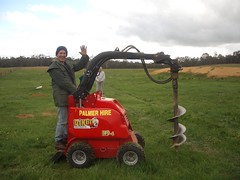

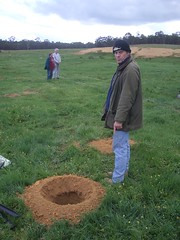
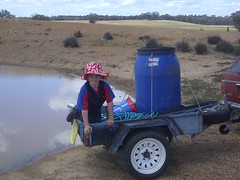
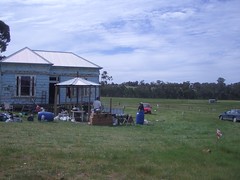
We planted around 120 trees in total - 70-plus lemon gums to line the
driveway, 30 olive trees up on the hill, and 15 fruit/nut trees as the
start of the orchard. We could only plant the most hardy kind of
trees this trip which could largely look after themselves, so we put
in 2 chesnuts, 5 persimmons, 2 apricot, 4 plums (two kinds)and 2
mulberries. I can't wait to seem them grow! It's brilliant also
because now it feels like we've started.
Despite how small the trees are at the moment, each one required a
huge effort to plant. After the hole was dug by the post hole
digger/tractor thing, the sides had to be chipped in so the roots
could spread out. Then we had to add compost, watering pipes, plant
the tree then lots of mulch. Then we hammered in the stakes (3 for
most, 4 for the bigger trees) and cut and tied wire around them to
protect from kangaroos, sheep, etc. Finally the finishing touch was
tying a square of shadecloth to the lid of each enclosure to provide
protection from frost (which usually hits by sinking down from above)
and also the sun this summer. Then the watering system... laying out
the pipes from the water tank, connecting the taps, digging the
trenches to bury the pipes for the parts cars might drive over.
We started on Thursday, marking out where each tree needed to go.
Friday and most of Saturday was drilling holes and driving stakes.
Planting started Saturday afternoon and continued until Monday
morning, as well as starting the wiring and irrigation system. Monday
afternoon and Tuesday morning were spent finishing the wiring and
attaching the shadecloth. So thanks again to everyone who helped, we
owe you bigtime.
had the flu for several days so was not much use) Saturday and Sunday were the biggest days, and Saturday night we had a BBQ by the stove and gazebo that Dad had built. The evening was finished off with fireworks, but the photos from that didn't work out unfortunately.
Here are a couple of photos
We planted around 120 trees in total - 70-plus lemon gums to line the
driveway, 30 olive trees up on the hill, and 15 fruit/nut trees as the
start of the orchard. We could only plant the most hardy kind of
trees this trip which could largely look after themselves, so we put
in 2 chesnuts, 5 persimmons, 2 apricot, 4 plums (two kinds)and 2
mulberries. I can't wait to seem them grow! It's brilliant also
because now it feels like we've started.
Despite how small the trees are at the moment, each one required a
huge effort to plant. After the hole was dug by the post hole
digger/tractor thing, the sides had to be chipped in so the roots
could spread out. Then we had to add compost, watering pipes, plant
the tree then lots of mulch. Then we hammered in the stakes (3 for
most, 4 for the bigger trees) and cut and tied wire around them to
protect from kangaroos, sheep, etc. Finally the finishing touch was
tying a square of shadecloth to the lid of each enclosure to provide
protection from frost (which usually hits by sinking down from above)
and also the sun this summer. Then the watering system... laying out
the pipes from the water tank, connecting the taps, digging the
trenches to bury the pipes for the parts cars might drive over.
We started on Thursday, marking out where each tree needed to go.
Friday and most of Saturday was drilling holes and driving stakes.
Planting started Saturday afternoon and continued until Monday
morning, as well as starting the wiring and irrigation system. Monday
afternoon and Tuesday morning were spent finishing the wiring and
attaching the shadecloth. So thanks again to everyone who helped, we
owe you bigtime.
Monday, September 20, 2004
more on the stove
Dad collected it last night, after a marathon effort. Here's his account of the night:
Email from Dad - 20/9/04
Hi,I got everything. Your stove is in excellent order for an old stove. Sure, there are some edges that are tattered, but over all you can be very proud of the stove. I got the water tank from the roof. It is the insulated type that I expected to be within the ceiling space, but there wasn't room so they put it outside on the top of the roof. All very suitable for Amherst. Salvaged the castiron pipe, and the steel flue. Very heavy. I lost control of the tank when lowering it from the roof and it fell a short distance before being pulled up short by the tied end of the rope. There was some wall damage to the ac sheeting. I felt like the guy ought to have something for the tank and since I damaged the wall I left him $300 for the lot as I left the site at 7 am. I spent a total of 10 hours getting the job done, and will spend $200 on groceries from your credit card as you said you would pay for that time. I worked all night, and was very fortunate all went very well with moving the stove. I have it in the carport now, and will take it and the stainglass, and some other things up to Amherst on Sunday. I have to hire the big trailer again so may as well take the big crate. I want to strongly encourage you to consider a lockup shed for Amherst when you make up your mind where you want it. I will put the stove into the house for now of course. I am very tired so will go for sleep now. I really enjoyed the photos and email you sent. I have read through it all, and looked the allotment. I am impressed with the size of the allotment. You can really make something of that size of allotment. Love Dad
Email from Dad - 20/9/04
Hi,I got everything. Your stove is in excellent order for an old stove. Sure, there are some edges that are tattered, but over all you can be very proud of the stove. I got the water tank from the roof. It is the insulated type that I expected to be within the ceiling space, but there wasn't room so they put it outside on the top of the roof. All very suitable for Amherst. Salvaged the castiron pipe, and the steel flue. Very heavy. I lost control of the tank when lowering it from the roof and it fell a short distance before being pulled up short by the tied end of the rope. There was some wall damage to the ac sheeting. I felt like the guy ought to have something for the tank and since I damaged the wall I left him $300 for the lot as I left the site at 7 am. I spent a total of 10 hours getting the job done, and will spend $200 on groceries from your credit card as you said you would pay for that time. I worked all night, and was very fortunate all went very well with moving the stove. I have it in the carport now, and will take it and the stainglass, and some other things up to Amherst on Sunday. I have to hire the big trailer again so may as well take the big crate. I want to strongly encourage you to consider a lockup shed for Amherst when you make up your mind where you want it. I will put the stove into the house for now of course. I am very tired so will go for sleep now. I really enjoyed the photos and email you sent. I have read through it all, and looked the allotment. I am impressed with the size of the allotment. You can really make something of that size of allotment. Love Dad
Saga of the star pickets
As part of the preparations for the great tree planting event (!) Dad is sourcing the materials we need. Each tree needs a guard around it to protect from kangaroos etc. Dad has come up with a design which requires using 3 or 4 star pickets for each tree. We considered several suppliers but eventually decided to get them from a nice man in Canberra who Dad found via a classified listing...it turned into quite an adventure!
Email from me to Chris Ward - 12th Sept
My Dad saw your ad on the allclassifieds site and asked me to get in touch to find out more. We are going to be planting about 100 trees in October and need 3-4 pickets per tree in order to build a protective fence around each tree to stop
kangaroos and sheep, etc. We're wondering if your pickets would be suitable.
How tall are they? Are they totally plastic, or are they metal coated in plastic? Would you consider splitting them and only selling say 400 rather than all 700 together? And finally, my Dad lives in Melbourne - are you willing to arrange shipment or would they need to be collected in person?
Reply from Chris - 12th Sept
They are all plastic, but very strong. They do sometimes break if they
are hit by a mob of large cattle at speed, but for sheep and kangaroos
they are perfect. We have used lots on our farm near Canberra to
protect individual trees, but since we have moved from sheep to cattle
we have reluctantly decided to go back to steel. I am sure we could
find a way to get them to Victoria, and yes, I can easily split the
posts. I have attached some information I downloaded a couple of years
ago when I bought them.
starposts.doc
Email from Dad - 13th Sept
I think you won't find a better deal for your longterm needs. I would buy as many of the pickets as you could afford, especially if they are 1.8 metre ones. I couldn't open the file attached even though I clicked often on it. It is a lot of money, but these things would cost more than steel ones, and for your purposes are more useful. Cutting them into shorter lengths is very much easier for starters, and they are safer around stock, as you can use them with electric fence for larger things as cattle and horses. Pickets are considered temporary style of fencing, and
flexible. Care to remove these intact is needed, but moving them about to accomodate your needs ought not to be a problem.. Remember that you will need to direct all sorts of animals, but when you have horses, these will be safer for your more or less permanent fencing about your garden areas because they will snap off if charged and not cause goring injury as likely as the steel ones. Whatever we do, we must plan to have safety matters in mind as well as other matters. Making channels about the place with post and rail fences is the safest way of directing horse traffic. That is for the future, and not now. Try to buy as many of these as you can afford, although I wish I could have opened the file so I could know more about
them. It is a lot of money, but so are the trees, when labour is factored in. They are worth their weight in water and shade once grown, and they are imperitive if you hope to enjoy a life there. When they are big in 5 yrs time, or sooner, the pickets will be used again to protect other such developments. I assume they are fully UV ray proof. Love Dad PS If he delivers to the railhead at Talbot, I could collect from there. Or if the rail is at Clunes, or whereever. They will hold such things for a short while.
Dad's email to Chris - 13th Sept
Hi, I am Lyn's dad and will be following up on the many preparations for her
visit to Melb in Oct, in about 4 weeks time. She needs to plant many trees,
and give them a chance to grow while amongst a flock of sheep, and having
regular visits by roos, and rabbits. I put up some wooden pegs, just garden
stakes, and many were knocked over by sheep because I couldn't drive them
into the hard ground deeply enough. I think the plastic ones you have may
be okay, but I couldn't open the attachment you sent to Lyn, and she sent on
to me. She is presently at work so I will continue this dialogue with you.
I think there is a rail head at Talbot or Clunes, but have to check on that
today. Obviously we need to decide if they are suitable first. What length
are they, are they like steel star pickets in that there are a range of
holes to receive rail wires for future use. I have pointed out to Lyn that
a picket which breaks off at the ground if a horse should charge it in a
panic could be an advantage. She will not be fencing a horse paddock with
such things, but will be riding all about the place on a horse in years to
come. Goring injuries by star pickets are very nasty. If you can reply asap to me today I would be thankful. Are all the pickets the same colour? Are they deteriorated by UV rays?
Chris's reply to Dad - 13th Sept
John, I have put the attachment in this email - hopefully you can read it. I haven't seen any sign of UV deterioration, and other than that they are plastic they are just like an ordinary star post - holes and all. The ones I have are black.
I just drive them in with a normal post driver - I sheared off about 6 or 7 out of about 300 in pretty rocky country. I run horses in a couple of paddocks and haven't had any problems with them at all. With cattle they seem to flex up to a certain point, and then snap cleanly at the base if put under extreme pressure. For horses, I would certainly prefer them to steel for the reasons you give. I am jammed in court for the rest of today, but should be free after 5.
Dad's email to me - 13th Sept
I have contacted the Meredith nursery site, and the tree guards they have
are unsuitable in the extreme. I contacted a firm specializing in
reforestration and revegetation and they have a plastic guard and something
like the nursery ones, a place called Tree Max or something like that. Not
suitable here. I contacted the place whose address you got from the Weekly
Times, and they have a lightweight metal garden stake for $2.50 same height
as the plastic star pickets, 1650mm, but he said if a sheep leaned on one it
would crumble easily. Not nearly as suited to reusability as permanent
fencing.
All the pickets Chris has are black, with holes just like the metal ones, so
can be "built-into" the rails of a permanent fence, a very critical point.
Downside is if a forest or grassfire goes through would probably burn,
though may not. No mention was made of this by the attachment info he
included. That considered, and the safer use around horses, I would see you
putting up permanent fencing with post and rail, and using these pickets for
partitioning paddocks and sheltering areas from stock as we are doing with
the trees, but on a more fencelike manner when more of your lanscaping is
done. Your water tanks, even galvanized, are not fire proof. But insurance
cover would fix these shortfalls. The price is very good if compared to the
normal retail price, but as you can get steel ones for $3.14 each the
difference is only 64 cents so I feel you should tell him you would buy all
from him if the price were $2.00 each. If $2.25 each only saving 89 cents
each, so cost of cartage means is not so good a deal. I am very taken with
the idea of plastic for safety, and with ease of cutting. Not so good with
the fire risk. So that is that. The place where you got the good price
from the Weekly Times is in Spotswood, near the Westgate bridge. He is
waiting for delivery of a container of the 1650 mm pickets, and would hold
the 400 pickets for us to pickup when I take the Jackaroo and trailer up.
The trailer for your car is there already. Dawn will leave your car at Jess
and Tony's, and suggest that Tony might drive it to pickup you at airport if
he is going to have difficulty fitting in all luggage. I plan to mount a
good packrack atop it before you arrive. I found a beaut on the roadside
castoff collection about 6 months ago.
I will contact Vic Rail about cost of shipping the plastic picket to
Melbourne. Please advise me soon as to your choices. I can get 1500 wide
roll of 25 mmx.9guage, the lightest,chicken wire 50 metres for $95. The
pickets are priced at $3.14 but must add GST so they are actually $3.46
each.
Summary: cost of steel pickets, which I will collect enroute to Amherst: 400
for $1384
Cost of plastic pickets: 400 for $1000. Must find out cost of freight.
Summary of my judgement: I would not hesitate to buy all 700, especially if
he will bring the price down to $2.25 or better still $2.00 each plus a fee
for delivering them to a railpoint for freighting here. The 25 cents saved
on 700 pickets comes to $175 so you could factor in $50 for him to deliver
to the place. Probably just settle on him delivering free and getting a
price off of 25-30 cents for buying all 700. You won't regret having the
pickets, but it is all money spent and you may not have it now. The big
cost item for the tree protection is obviously the pickets. Oh I forgot,
the roll of shadecloth comes in 1800 width and I forgot to get a price and
length of each roll. Love, Dad
Another email from Dad - 20th Sept 2004
I only just got to sleep today and Chris rang to tell me he was sending the pickets. He said they were going to only cost $75 and would be delivered to my doorstep tomorrow sometime. Hooray! The timing couldn't be better. I am getting cluttered here and will take the chance presented by Jen going to visit Gran this weekend to go to Amherst with the big load of pickets, leadlight, and stove. I must go late Sat night to beat the traffic, and because I have to be here for Mike and Margaret at Dawn's house for my birthday. So I will have a very full week. Next week I will be doing a big work time at Amherst, and not see you until at Amherst on Friday, most likely. Now the weather is our last concern, and guess what? We have had a day of 25 degrees today, and the prospect of spring weather continuing gets better and better. I have to study now, so will stop here. Oh, the reason I thought to send this message now- Chris said there have been 35 enquiries for his pickets. He is keeping the remainder for use on the farm. He has agistment of cattle, and when they have been spooked and charged the fence, it has collapsed at the ground level and not caused permanent damage to the beasts. So we have truly been fortunate to get these pickets when we did as the interest must have been delayed from when we contacted. Love Dad
Email from me to Chris Ward - 12th Sept
My Dad saw your ad on the allclassifieds site and asked me to get in touch to find out more. We are going to be planting about 100 trees in October and need 3-4 pickets per tree in order to build a protective fence around each tree to stop
kangaroos and sheep, etc. We're wondering if your pickets would be suitable.
How tall are they? Are they totally plastic, or are they metal coated in plastic? Would you consider splitting them and only selling say 400 rather than all 700 together? And finally, my Dad lives in Melbourne - are you willing to arrange shipment or would they need to be collected in person?
Reply from Chris - 12th Sept
They are all plastic, but very strong. They do sometimes break if they
are hit by a mob of large cattle at speed, but for sheep and kangaroos
they are perfect. We have used lots on our farm near Canberra to
protect individual trees, but since we have moved from sheep to cattle
we have reluctantly decided to go back to steel. I am sure we could
find a way to get them to Victoria, and yes, I can easily split the
posts. I have attached some information I downloaded a couple of years
ago when I bought them.
starposts.doc
Email from Dad - 13th Sept
I think you won't find a better deal for your longterm needs. I would buy as many of the pickets as you could afford, especially if they are 1.8 metre ones. I couldn't open the file attached even though I clicked often on it. It is a lot of money, but these things would cost more than steel ones, and for your purposes are more useful. Cutting them into shorter lengths is very much easier for starters, and they are safer around stock, as you can use them with electric fence for larger things as cattle and horses. Pickets are considered temporary style of fencing, and
flexible. Care to remove these intact is needed, but moving them about to accomodate your needs ought not to be a problem.. Remember that you will need to direct all sorts of animals, but when you have horses, these will be safer for your more or less permanent fencing about your garden areas because they will snap off if charged and not cause goring injury as likely as the steel ones. Whatever we do, we must plan to have safety matters in mind as well as other matters. Making channels about the place with post and rail fences is the safest way of directing horse traffic. That is for the future, and not now. Try to buy as many of these as you can afford, although I wish I could have opened the file so I could know more about
them. It is a lot of money, but so are the trees, when labour is factored in. They are worth their weight in water and shade once grown, and they are imperitive if you hope to enjoy a life there. When they are big in 5 yrs time, or sooner, the pickets will be used again to protect other such developments. I assume they are fully UV ray proof. Love Dad PS If he delivers to the railhead at Talbot, I could collect from there. Or if the rail is at Clunes, or whereever. They will hold such things for a short while.
Dad's email to Chris - 13th Sept
Hi, I am Lyn's dad and will be following up on the many preparations for her
visit to Melb in Oct, in about 4 weeks time. She needs to plant many trees,
and give them a chance to grow while amongst a flock of sheep, and having
regular visits by roos, and rabbits. I put up some wooden pegs, just garden
stakes, and many were knocked over by sheep because I couldn't drive them
into the hard ground deeply enough. I think the plastic ones you have may
be okay, but I couldn't open the attachment you sent to Lyn, and she sent on
to me. She is presently at work so I will continue this dialogue with you.
I think there is a rail head at Talbot or Clunes, but have to check on that
today. Obviously we need to decide if they are suitable first. What length
are they, are they like steel star pickets in that there are a range of
holes to receive rail wires for future use. I have pointed out to Lyn that
a picket which breaks off at the ground if a horse should charge it in a
panic could be an advantage. She will not be fencing a horse paddock with
such things, but will be riding all about the place on a horse in years to
come. Goring injuries by star pickets are very nasty. If you can reply asap to me today I would be thankful. Are all the pickets the same colour? Are they deteriorated by UV rays?
Chris's reply to Dad - 13th Sept
John, I have put the attachment in this email - hopefully you can read it. I haven't seen any sign of UV deterioration, and other than that they are plastic they are just like an ordinary star post - holes and all. The ones I have are black.
I just drive them in with a normal post driver - I sheared off about 6 or 7 out of about 300 in pretty rocky country. I run horses in a couple of paddocks and haven't had any problems with them at all. With cattle they seem to flex up to a certain point, and then snap cleanly at the base if put under extreme pressure. For horses, I would certainly prefer them to steel for the reasons you give. I am jammed in court for the rest of today, but should be free after 5.
Dad's email to me - 13th Sept
I have contacted the Meredith nursery site, and the tree guards they have
are unsuitable in the extreme. I contacted a firm specializing in
reforestration and revegetation and they have a plastic guard and something
like the nursery ones, a place called Tree Max or something like that. Not
suitable here. I contacted the place whose address you got from the Weekly
Times, and they have a lightweight metal garden stake for $2.50 same height
as the plastic star pickets, 1650mm, but he said if a sheep leaned on one it
would crumble easily. Not nearly as suited to reusability as permanent
fencing.
All the pickets Chris has are black, with holes just like the metal ones, so
can be "built-into" the rails of a permanent fence, a very critical point.
Downside is if a forest or grassfire goes through would probably burn,
though may not. No mention was made of this by the attachment info he
included. That considered, and the safer use around horses, I would see you
putting up permanent fencing with post and rail, and using these pickets for
partitioning paddocks and sheltering areas from stock as we are doing with
the trees, but on a more fencelike manner when more of your lanscaping is
done. Your water tanks, even galvanized, are not fire proof. But insurance
cover would fix these shortfalls. The price is very good if compared to the
normal retail price, but as you can get steel ones for $3.14 each the
difference is only 64 cents so I feel you should tell him you would buy all
from him if the price were $2.00 each. If $2.25 each only saving 89 cents
each, so cost of cartage means is not so good a deal. I am very taken with
the idea of plastic for safety, and with ease of cutting. Not so good with
the fire risk. So that is that. The place where you got the good price
from the Weekly Times is in Spotswood, near the Westgate bridge. He is
waiting for delivery of a container of the 1650 mm pickets, and would hold
the 400 pickets for us to pickup when I take the Jackaroo and trailer up.
The trailer for your car is there already. Dawn will leave your car at Jess
and Tony's, and suggest that Tony might drive it to pickup you at airport if
he is going to have difficulty fitting in all luggage. I plan to mount a
good packrack atop it before you arrive. I found a beaut on the roadside
castoff collection about 6 months ago.
I will contact Vic Rail about cost of shipping the plastic picket to
Melbourne. Please advise me soon as to your choices. I can get 1500 wide
roll of 25 mmx.9guage, the lightest,chicken wire 50 metres for $95. The
pickets are priced at $3.14 but must add GST so they are actually $3.46
each.
Summary: cost of steel pickets, which I will collect enroute to Amherst: 400
for $1384
Cost of plastic pickets: 400 for $1000. Must find out cost of freight.
Summary of my judgement: I would not hesitate to buy all 700, especially if
he will bring the price down to $2.25 or better still $2.00 each plus a fee
for delivering them to a railpoint for freighting here. The 25 cents saved
on 700 pickets comes to $175 so you could factor in $50 for him to deliver
to the place. Probably just settle on him delivering free and getting a
price off of 25-30 cents for buying all 700. You won't regret having the
pickets, but it is all money spent and you may not have it now. The big
cost item for the tree protection is obviously the pickets. Oh I forgot,
the roll of shadecloth comes in 1800 width and I forgot to get a price and
length of each roll. Love, Dad
Another email from Dad - 20th Sept 2004
I only just got to sleep today and Chris rang to tell me he was sending the pickets. He said they were going to only cost $75 and would be delivered to my doorstep tomorrow sometime. Hooray! The timing couldn't be better. I am getting cluttered here and will take the chance presented by Jen going to visit Gran this weekend to go to Amherst with the big load of pickets, leadlight, and stove. I must go late Sat night to beat the traffic, and because I have to be here for Mike and Margaret at Dawn's house for my birthday. So I will have a very full week. Next week I will be doing a big work time at Amherst, and not see you until at Amherst on Friday, most likely. Now the weather is our last concern, and guess what? We have had a day of 25 degrees today, and the prospect of spring weather continuing gets better and better. I have to study now, so will stop here. Oh, the reason I thought to send this message now- Chris said there have been 35 enquiries for his pickets. He is keeping the remainder for use on the farm. He has agistment of cattle, and when they have been spooked and charged the fence, it has collapsed at the ground level and not caused permanent damage to the beasts. So we have truly been fortunate to get these pickets when we did as the interest must have been delayed from when we contacted. Love Dad
Sunday, September 19, 2004
Ebay wins: urns and a stove
I'm writing in "real-time" now. I haven't caught up yet and it's going to take ages, so I decided to not worry about it, I'll work on it gradually but I don't want to fall even further behind.
So, this weekend... We drove up to a place just past Swindon to pick up some stone urns that I got on Ebay. The guy selling them had hundreds; I'm not sure where from but I didn't want to ask as I was guessing it could have been from an old cemetery. How else do you get lots of urns of different shapes and sizes? Anyway, they're really nice. About 40cm tall I'm guessing and they weigh a ton. They have a drainage hole in the bottom so you could mount them on a plinth and use them as planters. I figured they'd be good for Amherst, I can imagine them going really well in the herb garden. But in the interim I'll use them here.
Also this weekend we bought a stove. A lovely old Rayburn (or Raeburn as it was spelled in the Ebay listing). This is in Australia already and it's a woodburning stove. Apparently in good nick, just needs a new grate, but I'll find out for sure in a day or so when I hear from Dad. Here's a picture.

Based on looking at http://www.agashopaustralia.com/NewFiles/rayburnidentify.html
we think it is either a model 2 or model 3. Either way, Either way, judging from to http://www.aga-rayburn.co.uk/37.htm it is probably from the late 1940's or 1950's.
The only horrible part of the stove is having to collect and move it. Poor Dad is collecting it for us, and because the guy we're buying it from is insisting it be moved before Wednesday (this is for an auction finishing on the Sunday!!) the only time Dad could do it was Monday morning - ie: right now. So he drove up there late, is planning to sleep there, and then work on getting the stove out as soon as it gets light. He's hiring a special trailer with a winch in order to lift it, etc. Dad is brilliant at helping with all of this as he always knows what to do; I didn't even know trailers with winches existed, let alone knowing where to rent one from with little notice. But Dad does. I just feel awful having to ask him to help though as he's so busy with other things.
So, this weekend... We drove up to a place just past Swindon to pick up some stone urns that I got on Ebay. The guy selling them had hundreds; I'm not sure where from but I didn't want to ask as I was guessing it could have been from an old cemetery. How else do you get lots of urns of different shapes and sizes? Anyway, they're really nice. About 40cm tall I'm guessing and they weigh a ton. They have a drainage hole in the bottom so you could mount them on a plinth and use them as planters. I figured they'd be good for Amherst, I can imagine them going really well in the herb garden. But in the interim I'll use them here.
Also this weekend we bought a stove. A lovely old Rayburn (or Raeburn as it was spelled in the Ebay listing). This is in Australia already and it's a woodburning stove. Apparently in good nick, just needs a new grate, but I'll find out for sure in a day or so when I hear from Dad. Here's a picture.
Based on looking at http://www.agashopaustralia.com/NewFiles/rayburnidentify.html
we think it is either a model 2 or model 3. Either way, Either way, judging from to http://www.aga-rayburn.co.uk/37.htm it is probably from the late 1940's or 1950's.
The only horrible part of the stove is having to collect and move it. Poor Dad is collecting it for us, and because the guy we're buying it from is insisting it be moved before Wednesday (this is for an auction finishing on the Sunday!!) the only time Dad could do it was Monday morning - ie: right now. So he drove up there late, is planning to sleep there, and then work on getting the stove out as soon as it gets light. He's hiring a special trailer with a winch in order to lift it, etc. Dad is brilliant at helping with all of this as he always knows what to do; I didn't even know trailers with winches existed, let alone knowing where to rent one from with little notice. But Dad does. I just feel awful having to ask him to help though as he's so busy with other things.
Monday, August 30, 2004
More discussion on the cottage
When I went to Amherst the first time and saw where Mum and Dad were proposing to build the cottage I said no. It was on the peak of the hill and so would have been in full view. Instead I said they could build the cottage down the other side of the hill, so that it couldn't be seen from the main house (and is further away).
Here's a few of the email exchanges discussing the shape of cottage:
Email to Mum - 25th Aug
Our first edition of Mother Earth news arrived today, and amidst all
the semi-hippy stuff there were some really good articles, even Dave
was impressed.
A great how-to guide on making a natural swimming pool/pond which we
were wanting to do anyway but hadn't got round to finding details.
And an article about yurts. They look quite interesting, not like
camping tents, they can be quite flash. e.g., check out the two
storey one here. http://www.abc.net.au/canberra/stories/s876255.htm
A yurt might be a quick way of getting some housing to live in up
there while we were doing work, and double as spare cottage later? It
would have to be carefully positioned so as not to look odd, but the
one in the abc article above I could see blending in. I'm not totally
sold yet but it is an option to consider
Here are some suppliers of yurts, all in the US but give you an idea of pictures
http://www.advancecanvas.com/index.htm
http://www.nestingbird.com/
http://www.yurts.com
http://www.yurtworks.com/
And it seems like maybe they are good for bushfire protection too?
Found this on a post: "Our 15ft yurt in the Brindabella Valley, NSW,
Australia. It has been up since 1981 and withstood the ravages of the
recent bushfires here in a way that was quite bizarre. Two huge
bushfires that destroyed 300 homes in the capital city Canberra, both
swept over the yurt from different directions a week apart. Despite
there being full petrol containers under the yurt and the fact that it
had been painted with old motor oil, the shape of the structure seemed
to somehow move the fire front over and around the building so that it
didn't burn. No one can work out why it didn't go up as everything
around it was badly burned, but that's my theory anyway".
And here is a link to the only Australian supplier of yurts in kit form
http://yurtworks.com.au
If you look in their photos section you see they are the ones who did
that cool double storey yurt. I can see that working really well on
our block nestled into the slope. It is kind of like a hobbit house
in feel but taller and narrower, don't you think?
Mum's reply - 25 Aug
Yurts are fine - but what about a hobbit hole? Half buried in the land,
just the front showing and even that made with the stone on the site?
Also bushfire "safe" - well safer than a normal house. Stable in
temperature, ie well insulated. You can grow things on the roof because
that is just land.. If a yurt was to be a permnanent thing, built
conventionally, it would not be as easy as a normal house because of all
the angles to be cut. A "proper" yurt is round though the couple I
looked at were something like a duodecahedron or similar.
Although, the yurts do have a sort of feel of a hobbit house.
I was looking at the prices - I am inclined to think, without actually
running to the timber yard, that it is expensive for effectively just
the wodd cut to size. Of course, you are also paying for their
knowledge and working out of the lengths to cut, and the angles - I note
they seem to be 22 sided figures. I also note the windows are cheap
aluminium ones. Add into the equation that Dad has certain things lying
about that he would give you - second hand stuff he could scrounge and
you would never know, and so on. I think you could get a more
conventional room or two built for less than that if Dad did it.
Note that the $5000 odd was just for the frame, inside and outside
lining, roof and maybe insulation - you had to supply all else yourself.
The sort of place Dad was talking about building when you came back in
June would fit in well to the landscape. That was not a hobbit house,
which was something Dad said he would like to build one day - perhaps
in his own back yard. Not that I think his land slopes enough to make
it easy.
My reply - 30th Aug
Yes, you're right, the prices of the yurt kits are a little more than
I'd first thought. But it's an idea to add to the mix. I like the
octagonal shape. I don't much like the canvas traditional ones even
though I know they are the proper yurts.
Dad can still build a house as he was talking about it before at
Amherst, but just not in the position on the top of the hill. e.g.,
Why not on the other side of the hill so it was nestled in the slope,
with a view to the right over to Snake dam, and to the left down the
valley? I think you'd get similar views, albeit not quite as
panoramic, and it would be mostly out of sight of the other house,
except maybe for the roof etc. I don't want it out of sight because
I'm worried about what it would look like, it is more because I don't
want to spoil the effect of the main house being secluded. Also, we
now have plans for the slope up to the top in terms of garden, with a
natural swimming pool/pond at the base.
Mum's reply - 30th Aug
Fair enough - it would be good round the other side of the hill. We
were trying to make it out of sight of the hosue itself you know - it
would be much lower than your house so you sould not see it, though the
roof of your place would have been seeable from the little place. But,
it would certainly have been visible from the drive and the road and the
far side of the hill will not be.
Here's a few of the email exchanges discussing the shape of cottage:
Email to Mum - 25th Aug
Our first edition of Mother Earth news arrived today, and amidst all
the semi-hippy stuff there were some really good articles, even Dave
was impressed.
A great how-to guide on making a natural swimming pool/pond which we
were wanting to do anyway but hadn't got round to finding details.
And an article about yurts. They look quite interesting, not like
camping tents, they can be quite flash. e.g., check out the two
storey one here. http://www.abc.net.au/canberra/stories/s876255.htm
A yurt might be a quick way of getting some housing to live in up
there while we were doing work, and double as spare cottage later? It
would have to be carefully positioned so as not to look odd, but the
one in the abc article above I could see blending in. I'm not totally
sold yet but it is an option to consider
Here are some suppliers of yurts, all in the US but give you an idea of pictures
http://www.advancecanvas.com/index.htm
http://www.nestingbird.com/
http://www.yurts.com
http://www.yurtworks.com/
And it seems like maybe they are good for bushfire protection too?
Found this on a post: "Our 15ft yurt in the Brindabella Valley, NSW,
Australia. It has been up since 1981 and withstood the ravages of the
recent bushfires here in a way that was quite bizarre. Two huge
bushfires that destroyed 300 homes in the capital city Canberra, both
swept over the yurt from different directions a week apart. Despite
there being full petrol containers under the yurt and the fact that it
had been painted with old motor oil, the shape of the structure seemed
to somehow move the fire front over and around the building so that it
didn't burn. No one can work out why it didn't go up as everything
around it was badly burned, but that's my theory anyway".
And here is a link to the only Australian supplier of yurts in kit form
http://yurtworks.com.au
If you look in their photos section you see they are the ones who did
that cool double storey yurt. I can see that working really well on
our block nestled into the slope. It is kind of like a hobbit house
in feel but taller and narrower, don't you think?
Mum's reply - 25 Aug
Yurts are fine - but what about a hobbit hole? Half buried in the land,
just the front showing and even that made with the stone on the site?
Also bushfire "safe" - well safer than a normal house. Stable in
temperature, ie well insulated. You can grow things on the roof because
that is just land.. If a yurt was to be a permnanent thing, built
conventionally, it would not be as easy as a normal house because of all
the angles to be cut. A "proper" yurt is round though the couple I
looked at were something like a duodecahedron or similar.
Although, the yurts do have a sort of feel of a hobbit house.
I was looking at the prices - I am inclined to think, without actually
running to the timber yard, that it is expensive for effectively just
the wodd cut to size. Of course, you are also paying for their
knowledge and working out of the lengths to cut, and the angles - I note
they seem to be 22 sided figures. I also note the windows are cheap
aluminium ones. Add into the equation that Dad has certain things lying
about that he would give you - second hand stuff he could scrounge and
you would never know, and so on. I think you could get a more
conventional room or two built for less than that if Dad did it.
Note that the $5000 odd was just for the frame, inside and outside
lining, roof and maybe insulation - you had to supply all else yourself.
The sort of place Dad was talking about building when you came back in
June would fit in well to the landscape. That was not a hobbit house,
which was something Dad said he would like to build one day - perhaps
in his own back yard. Not that I think his land slopes enough to make
it easy.
My reply - 30th Aug
Yes, you're right, the prices of the yurt kits are a little more than
I'd first thought. But it's an idea to add to the mix. I like the
octagonal shape. I don't much like the canvas traditional ones even
though I know they are the proper yurts.
Dad can still build a house as he was talking about it before at
Amherst, but just not in the position on the top of the hill. e.g.,
Why not on the other side of the hill so it was nestled in the slope,
with a view to the right over to Snake dam, and to the left down the
valley? I think you'd get similar views, albeit not quite as
panoramic, and it would be mostly out of sight of the other house,
except maybe for the roof etc. I don't want it out of sight because
I'm worried about what it would look like, it is more because I don't
want to spoil the effect of the main house being secluded. Also, we
now have plans for the slope up to the top in terms of garden, with a
natural swimming pool/pond at the base.
Mum's reply - 30th Aug
Fair enough - it would be good round the other side of the hill. We
were trying to make it out of sight of the hosue itself you know - it
would be much lower than your house so you sould not see it, though the
roof of your place would have been seeable from the little place. But,
it would certainly have been visible from the drive and the road and the
far side of the hill will not be.
Subscribe to:
Posts (Atom)